
Requirements and design
We listen to the people who use the reports and agree what the system must do.



Services built around the report
ABI helps industrial teams connect data, check what needs attention, prepare clearer reports and keep the underlying process maintained. The work is scoped around the decisions your reports need to support.
 Illustration
How ABI works
ABI sets up Presoris, a platform already built for production data, and shapes it to your plant. That means reliable reports sooner, a lower cost, less risk and a system that is easier to keep running.
 Reports sooner. With ready made building blocks for production data, which means your first trusted reports arrive sooner.Lower cost and less risk. With much less custom building, which means a lower cost and fewer surprises along the way.Problems caught early. With monitoring built in from day one, which means problems are spotted before they reach a report.Skills on hand. With our team on hand, which means you get database and reporting skills without hiring them.
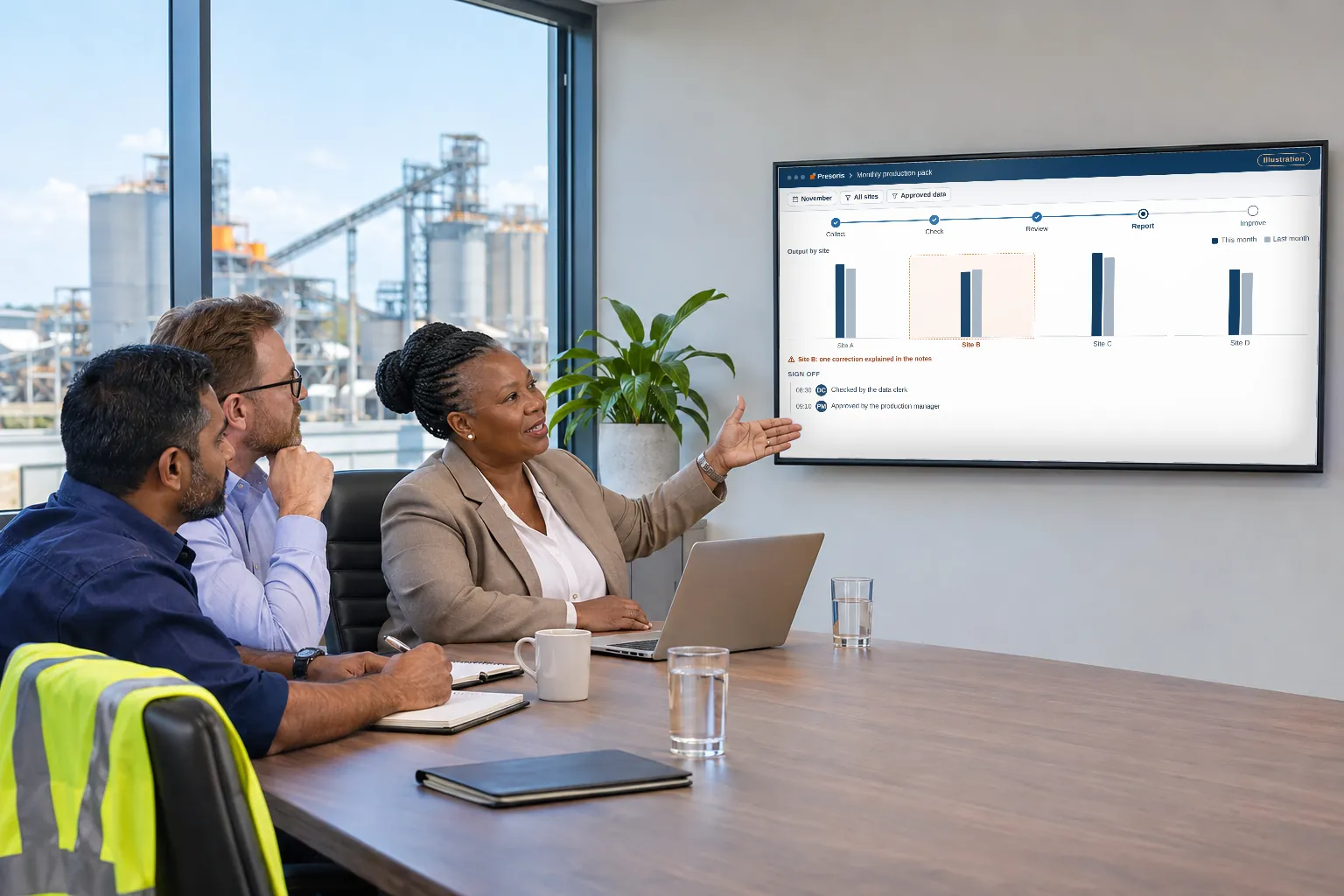
Illustration: a concept photo with a sample screen. Not a client meeting or a screenshot.
What we do
We listen to the people who use the reports and agree what the system must do.

Data capture, checks, sign off steps and connections to your other systems, done for you.

Built on standard structures, and extended only where your process needs it.

Reports, dashboards and the numbers you track (your KPIs), built on approved data.

From your machines (through PLCs, their control systems), from manual entry and from third party systems.

We keep watch, fix problems and look after the system after go live.
The problem
Does this sound familiar?
Data is pulled together by hand from many systems.Hours go into building the same Excel reports every week.There is more than one version of the truth.Wrong production numbers reach finance.People do not trust the reports, so they keep their own.
The customer story
When a report draws on several systems, the challenge is rarely the chart alone. Someone still has to gather information, check it, resolve gaps and explain the final figure. ABI’s services address that work as a connected reporting journey.
BeforePeople repeatedly export and combine data. A number doesn’t match. The team has to trace the source and decide which record to use, often while a review is waiting.
 The change
Agree the sources, rules, review steps and reports. Make exceptions visible and set out who investigates or approves a correction.
AfterThe team has a more consistent report workflow and a better basis for discussing what happened, what still needs checking and what action follows.
When the same report is rebuilt from several places
Production figures are spread across automated process systems, databases and manual records. Someone exports the data, combines it, checks formulas and turns it into a familiar spreadsheet pack. The effort repeats, and the source of a disputed figure is not always obvious.
The desired changeA defined route from agreed data sources to the report people need, so review time is spent discussing production rather than rebuilding the pack.
What needs confirming: available connectors, source ownership, data access, reporting tools, infrastructure and security review are assessed for each environment. ABI does not assume every source or ERP can be connected.
When the report contains a number nobody wants to defend
An incomplete, duplicated or unexpected value can weaken confidence in the entire report. If the issue is noticed late, the team has to reconstruct what happened and chase the person or system that can explain it.
The desired changeMake agreed checks part of the reporting workflow. Surface records that need attention, give the right people a way to investigate them, and preserve context around approved changes where the configured process supports it.
 Monthly / analysis
Review agreed data-quality rules, improve them where needed, configure exception notifications and provide a monthly summary of activity.
Why it helps: the checks can evolve with the operational measures the business needs to rely on.
 Daily / management
Monitor the support process, investigate data-quality exceptions, liaise with client engineering teams on logging issues and carry out agreed manual data repairs.
Why it helps: the issue can be tracked and worked through rather than left buried in a report.
Weekly / maintenanceMaintain reporting databases and procedures, improve report performance, and manage access and subscriptions as scoped in the service agreement.
Why it helps: there is planned attention for the systems supporting day-to-day reporting.
Boundary: data-quality monitoring can identify and help manage reporting exceptions. It does not itself prevent every PLC, network or SCADA fault; source-system remediation remains a coordinated engineering responsibility.
When people need a better view, not another pile of charts
Teams may have reports, but still struggle to answer basic questions quickly: what changed, where did the variance start and which figures are ready to use? A dashboard that simply repeats uncertain inputs does not solve that.
The desired changeUseful reporting that reflects agreed definitions and provides appropriate context for operational conversations.
Report tool, hosting and source-system fit are confirmed during discovery. This mockup does not assume Power BI or another named platform is part of every ABI project.
When reporting works but nobody has time to look after it
Reports and databases need routine attention. Access requests, subscriptions, performance problems and changes to data-quality rules continue after launch. Without an owner, the reporting environment gradually becomes harder to maintain.
The desired changeAgreed maintenance tasks and a route for ongoing issues, matched to the systems and support responsibilities at the site.
Define database, report and rule tasks in the service agreement, which means expectations are clear before ongoing support starts.
Use an agreed cadence for maintenance and reporting activity, which means teams have a place to raise recurring issues.

Coordinate with the client’s engineering and IT teams on infrastructure and source-system responsibilities, which means issues can be routed to the right owner.

Confirm what the site needs and ABI can support, which means the SLA can reflect the actual reporting workload.

What happens next
01 / DescribeTalk through the report that is slowest to prepare, hardest to reconcile or most often questioned.
02 / MapIdentify users, sources, definitions, checks, owners and constraints before deciding on a solution.
 03 / Agree
ABI outlines a suitable project or support scope, dependencies and responsibilities for review.
Before you commit
The published offer focuses on data collection, data quality, reporting and support around existing industrial information. A replacement is not assumed. The role of current systems is mapped first.
ABI’s data-quality service can surface reporting exceptions and coordinate with client engineering teams. The actual fault in a source system needs to be diagnosed and resolved by the responsible technical team.
The ABI discussion describes workflows where a reviewed manual value or correction may be possible, with provenance. Whether that applies depends on the current product configuration and client process. It should be confirmed before a project or public claim.
Timing depends on source systems, access, data condition, scope and client-side responsibilities. ABI should confirm a delivery estimate after understanding those dependencies.
ABI has described monthly data-quality analysis, daily data-quality management and weekly database/report maintenance. The service agreement should define response coverage, hours, responsibilities and current tooling for each client.
Start with a real workflow
If you are ready to stop rebuilding the same report every week, start with a short conversation. Share the report, its sources and what keeps creating rework. ABI can help determine whether the fit is data integration, reporting, data-quality support or maintenance.